
Minimalist Strategies to Eliminate Distractions Boost Personal Organization

Embracing a Minimalist Mindset
In a world inundated with constant notifications, endless tasks, and overwhelming choices, finding peace and productivity can feel impossible. The practice of minimalism offers a refreshing approach to tackle these challenges by focusing on what truly matters. By stripping away the excess, individuals can create environments that foster clarity and efficiency.
The Importance of Personal Organization
Effective personal organization is more than just keeping a tidy space; it’s about cultivating mental clarity and prioritizing tasks that contribute to your goals. This is where minimalism shines, as it encourages a lifestyle free from distractions and clutter. The relevance of minimalism in personal organization is profound, with research suggesting that simplified environments can significantly reduce stress levels and enhance productivity.
What to Expect
In this article, we will explore the Top 5 minimalist strategies to eliminate distractions and boost your personal organization. Each strategy will not only inspire you to declutter your physical space but also help streamline your mental processes. Prepare to discover actionable tips that can transform your daily routine and lead you to a more focused and organized life.
Top 5 Minimalist Strategies to Eliminate Distractions and Enhance Your Personal Organization
In an era dominated by rapid technological advancements and a high-pressure lifestyle, personal productivity and organization have become challenging goals to achieve. The constant influx of notifications, tasks, and information often leads to mental chaos, hampering our ability to focus effectively. Embracing minimalism offers a refreshing and practical approach to tackling these distractions, helping individuals streamline their lives to achieve personal and professional aspirations. While many associate minimalism solely with physical decluttering, it profoundly extends to mental and digital spaces as well. Here, we delve into five essential minimalist strategies designed to eliminate distractions and enhance personal organization.
5. Digital Declutter
In the contemporary, fast-evolving digital landscape, many of us find our lives intertwined with technology. From smartphones to laptops, the devices we rely on daily serve both as tools and sources of incessant distraction. Engaging in a digital declutter is a crucial step toward reclaiming control over our time and focus. Start by paying close attention to the digital content you consume and accommodate:
- Unsubscribe from irrelevant newsletters and email lists to reduce the clutter in your inbox, focusing on contents that genuinely add value.
- Evaluate and delete unused applications occupying your devices. These apps not only take up space but also often intrude through notifications.
- Organize files into clearly labeled folders, categorizing them by projects, urgency, or personal interest to enhance retrieval efficiency.
This digital pruning reduces the background noise competing for your attention, encouraging a more structured and distraction-free workflow. Incorporating specific time blocks to check emails and notifications rather than responding in real time fosters uninterrupted productivity. For instance, dedicating time in the morning, midday, and evening to manage emails can drastically reduce snap distractions throughout the day.
4. Time Blocking
The concept of time blocking has been gaining traction among productivity enthusiasts, and for a good reason. By setting aside fixed periods throughout the day dedicated to specific tasks or activities, time blocking minimizes the temptation to multitask, a practice that often diffuses focus and efficiency. To effectively adopt time blocking, consider these steps:
- Identify your most productive hours, and allocate these periods to crucial tasks requiring maximum concentration.
- Schedule focused work sessions and protect them from interruptions. Use tools or do-not-disturb functionalities to shield these blocks.
- Incorporate regular breaks to recharge mentally and physically, preventing burnout and maintaining sustained productivity.
This structure allows you to track progress easily and adjust as needed, enhancing both focus and achievement. A study by the American Psychological Association revealed that downtime significantly improves memory and learning, which underscores the importance of strategic breaks.
3. Mindfulness Practices
Your mind is a powerful asset in battling distractions, and mindfulness is a tool that can empower this asset. Mindfulness practices nurture a heightened state of awareness and enhance cognitive control. Implementing these practices helps you remain present and focused, combing through distractions with greater ease. Consider integrating these mindfulness techniques:
- Engage in daily meditation sessions, even if only for 5-10 minutes, promoting mental clarity and reducing stress.
- Take mindful breaks throughout your work hours to allow yourself moments of reflection, ensuring you don’t operate on autopilot.
- Practice breathing exercises to anchor your thoughts, making it easier to redirect attention once distractions arise.
An interesting study by Harvard University found that mindfulness practices could reduce mind-wandering, a known productivity killer, by up to 50%, enhancing one’s ability to focus effectively on tasks.
2. Simplified Workspace
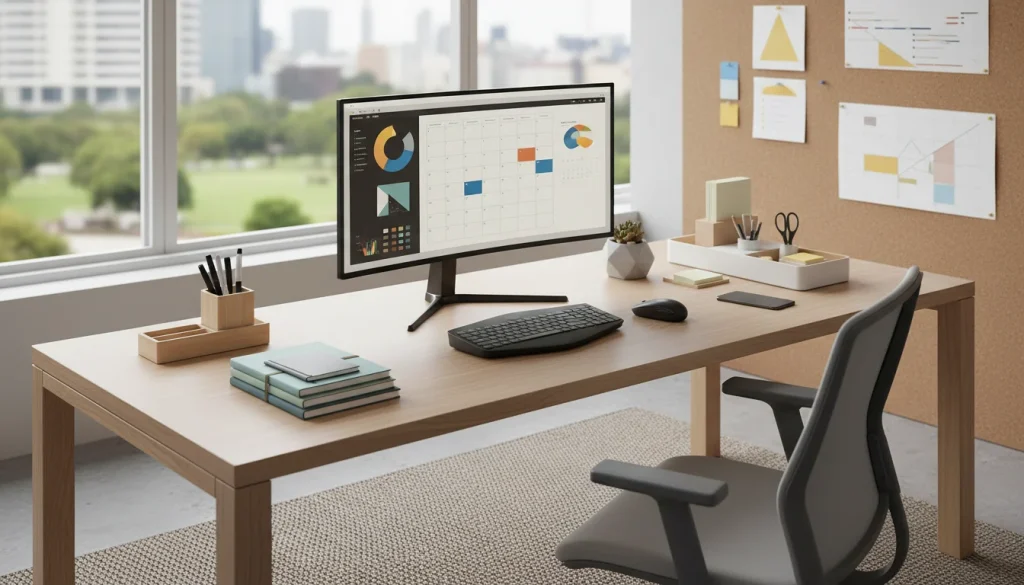
The environment where you work tells a story about your mental state. A simplified workspace can significantly boost your ability to concentrate and remain organized. A clutter-free desk limits physical distractions while promoting a clear and creative mind. Here are some actionable steps:
- Remove unnecessary items from your desk, reducing the visual clutter that can promptly deviate focus.
- Utilize organizers to keep essential materials orderly, ensuring everything has its place and is easily reachable.
- Incorporate only items that inspire or support your work, like a motivational quote or a plant for added freshness.
A study published in the Journal of Environmental Psychology demonstrates a direct connection between an organized workspace and increased productivity levels, highlighting the importance of crafting a workspace conducive to focused work.
1. Defining Goals and Priorities
At the crux of minimalism lies the clarity of purpose. The act of defining clear goals and priorities serves not only as a map to your destination but also a template for aligning your daily activities. Without a precise understanding of your objectives, it’s easy to meander through distractions. To ensure your goals serve as beacons guiding your actions, consider the following:
- Write down your goals, both short and long-term, creating a manifest of your aspirations and intended achievements.
- Identify actionable steps necessary to achieve those goals, breaking down larger tasks into manageable portions.
- Prioritize tasks based on relevance and urgency, focusing on necessities and eliminating redundancies.
When your objectives are clearly defined, distractions become easier to resist. You create a focused platform that not only fosters organization but also cultivates intentionality. According to a study by Dominican University of California, individuals who write down specific goals are more likely to accomplish them, emphasizing the effectiveness of clarity and intention.
In conclusion, adopting these minimalist strategies provides a pathway to reclaim control over your productivity and personal organization. By decluttering your digital and physical spaces, using time wisely through effective scheduling, embracing mindfulness, and focusing intently on clear, defined goals, you can curate an environment that inherently supports efficiency and clarity. Embrace these strategies and transform the way you engage with your tasks, enhancing your journey to a more organized, distraction-free life.
| Category | Details |
|---|---|
| Prioritization Techniques | Implementing methods like the Eisenhower Matrix can categorize tasks into urgent and important, allowing for effective decision-making. |
| Digital Minimalism | Reducing digital clutter by organizing applications and decluttering emails can significantly enhance focus and productivity levels. |
| Time Blocking | Allocating specific time slots for tasks can provide a structured approach, helping to maintain concentration and prevent distractions. |
| Mindfulness Practices | Incorporating techniques such as meditation can improve focus and enhance overall well-being, allowing for better organizational capabilities. |
In today’s fast-paced environment, distraction is an ever-looming threat to personal organization. Prioritization techniques emerge as essential tools in combatting this constant challenge. The Eisenhower Matrix, for instance, empowers individuals to distinguish between what is urgent and what is important, leading to more informed decision-making that can influence time management skills tremendously. This method not only aids in clarity but also promotes a structured approach to tackling daily tasks, minimizing wasted effort.Digital minimalism plays a significant role in alleviating distractions too. By decluttering the digital workspace, individuals can experience a freshness that invigorates productivity. Streamlining applications and effectively managing emails can create a more serene digital environment. This is especially crucial when you consider how often distractions emerge from unnecessary notifications and digital noise.Time blocking is another strategy that resonates well in the realm of minimalism. By dedicating specific time slices for particular activities, the risk of multitasking—often a catalyst for distraction—can be significantly reduced. This focused time allows individuals to immerse themselves in their work, leading to heightened productivity and sharper concentration.Additionally, the incorporation of mindfulness practices shouldn’t be overlooked. Techniques like meditation offer a sanctuary from the chaos of everyday life. Regular practice can not only enhance focus but also promote mental clarity, enabling better organization and decision-making. As more individuals adopt such practices, the collective improvement in personal management becomes more pronounced.These strategies, when embraced collectively, provide a profound pathway toward minimalism and enhanced organization. The journey toward eliminating distractions is gradual, yet the benefits reaped through their implementation can profoundly transform personal and professional landscapes.
Frequently Asked Questions: Minimalist Strategies for Eliminating Distractions and Enhancing Personal Organization
What are minimalist strategies, and how can they help reduce distractions?
Minimalist strategies focus on simplifying your environment and routines to reduce mental and physical clutter. By removing unnecessary items and distractions, you create a space conducive to focus and productivity. This approach can lead to a more streamlined life, making it easier to prioritize what truly matters. Implementing minimalist strategies like decluttering your workspace, setting clear priorities, and limiting digital distractions can significantly improve your concentration and efficiency.
How can minimalism improve my personal organization?
Minimalism promotes the idea of owning fewer possessions, which translates to less to manage, clean, and keep track of. By reducing excess, you can create a more organized environment where every item has its place and purpose. This can lead to quicker cleaning routines, easier decision-making, and an overall sense of tranquility. Moreover, having a minimalist mindset encourages intentional living—making conscious choices about what to keep in your life, leading to better organization and focus.
Are there any digital tools that support minimalist organization?
Yes, there are several digital tools designed to help maintain a minimalist approach to personal organization. Apps like Notion, Todoist, and Evernote offer features for task management and note-taking without overwhelming you with options. These tools help cut through the noise and provide a clean, simple interface designed to enhance focus and productivity. When using these tools, it’s crucial to not overcomplicate usage; maintain only the features that genuinely benefit your workflow.
What are some common challenges when implementing minimalist strategies?
One common challenge is the initial difficulty of letting go of possessions or habits that have been part of your life for a long time. There’s often an emotional attachment that can be hard to navigate. Another challenge is resisting the temptation to acquire more things or overcommit your time. It’s essential to continuously evaluate and adjust your strategies to suit your evolving priorities. Additionally, finding a balance where minimalism doesn’t interfere with essential aspects of life, like relationships or hobbies, can also present a challenge.
Conclusion: Embracing Minimalist Strategies for Personal Organization
In today’s fast-paced world, where distractions abound at every corner, adopting a minimalist approach has never been more crucial. By focusing on what’s truly important and eliminating excess, we stand to gain not just a tidier space but also a clearer mind. This article explored how minimalism serves as a powerful tool to help individuals enhance personal organization and reduce distractions.
Among the strategies discussed, the significance of decluttering physical spaces emerged as a fundamental step. By removing unnecessary items, individuals can create an environment that promotes focus and efficiency. Equally important, digital decluttering helps minimize digital noise, which is often a major source of modern-day distractions. It encourages us to adopt organized digital habits that align with our minimalist goals.
Furthermore, setting clear priorities plays a vital role in managing commitments and tasks. By understanding what truly matters, we can allocate our time and energy more effectively. Additionally, striking a balance between minimalist practices and productivity ensures that while we simplify, we also pursue our personal and professional goals efficiently.
Mindfulness also contributes significantly to individual focus and productivity. By practicing being present, we stay attentive to tasks at hand, thereby reducing internal and external distractions. Integrating these strategies into daily life isn’t merely about making room for more; it’s about enhancing the quality of our space and how we engage with it.
In summary, minimalism offers a fresh perspective on managing personal organization. These strategies serve as a guideline for individuals seeking clarity and efficiency in their lives. Embracing minimalism not only leads to a more organized life but also fosters a deeper sense of purpose and well-being.